Tamagoyaki Recipe Food Japan
Tamagoyaki recipe is a popular food in Japan. It is one of the dishes that Japanese people take pride in when they invite guests from abroad to their home. It is not difficult at all to make tamagoyaki recipe if you follow this tamagoyaki recipe step by step, even a beginner can do it well. In addition, we will explain how to make tamagoyaki recipe in a sweet way, which is also popular.
 |
| Tamagoyaki |
What are the ingredients of this tamagoyaki recipe? First of all let's look at what we need for tamagoyaki recipe:
- eggs, preferably large eggs or even better jumbo eggs (size more than 60g) per person
- mirin (sweet cooking rice wine) or sugar;
- soy sauce: 1.5 tbsp (20ml) per 4 eggs;
- vinegar: 2 tsp (10ml);
- salt, ground pepper, dashi powder (dried fish stock), optional seasonings;
- nori seaweed: 1/4 sheet or 2 sheets (about 10g) per tamagoyaki;
- other optional ingredients: spring onion, cheese (yogurt cheese), shiso leaf, sesame seeds or ground sesame seeds.
Instructions
for tamagoyaki recipe:
First we need to gather all ingredients. One way is to make a list of ingredients and write down the amounts that you use on this list. This would be very helpful for cooks who want to improve their cooking skills as they can review the recipe at any given time. Then follow these steps according to this tamagoyaki recipe step by step:
Next we make a round tamagoyaki. Use a rectangular non-stick frying pan (about 20 x 15 cm) and brush the bottom and sides with oil. Make sure there is no water left in it. This will help us to prevent uneven heat distribution when making tamagoyaki, which can result in burnt edges. If we make tamagoyaki with a lot of oil, then the eggs would be more moist and not burnt easily.
Then break each egg separately into a small bowl. This way it is easier to add one by one into the frying pan, which will help us to avoid breaking all eggs at once when adding them. This tamagoyaki recipe step is shown in the following picture;
Then we add one egg into the frying pan and let it cook for 15 seconds, or until the egg white gets a bit of color, but not completely cooked (pale yellow or almost white). Then we roll this egg from side to side with a spatula while adding the next egg. We continue this tamagoyaki recipe step until all eggs are used up and form a round shape as in the following picture:
At this point, we have tamagoyaki with raw edges, not cooked through. If you want your tamagoyaki to be more moist, slightly undercooked is fine. If you want the tamagoyaki to be slightly crunchy, then cook it through. But if we don't use oil for brushing, then the edges will be very dry and hard because there is not enough moisture in the pan. We can also make tamagoyaki with spring onion or cheese (as shown in this picture) or other ingredients, it is up to your imagination.
Next step in this tamagoyaki recipe: the so-called 'tamagoyaki wrap'. Take a sheet of nori seaweed and place it on top of the tamagoyaki as shown in the picture below. If you are making tamagoyaki with spring onion or cheese, then please do the wrap next. This is because we don't need to roll tamagoyaki with spring onion or other ingredients inside in this step.
This 'tamagoyaki wrap' means that the seaweed sheet is wrapped around the tamagoyaki before it is cooked further. The purpose of doing so is to make tamagoyaki more crispy. If we just cook tamagoyaki normally without wrapping it with nori seaweed, then the edges of tamagoyaki would be too hard and even burnt while the middle part is still moist.
Then roll this 'tamagoyaki wrap' tightly by holding it from both ends as shown in the following tamagoyaki recipe step. If you want, you can cut this wrapped tamagoyaki with scissors into a desired shape and size as shown in the picture below:
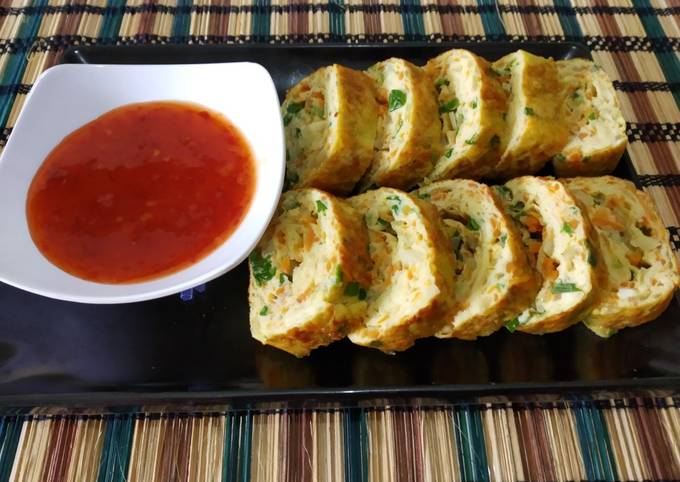 |
| Tamagoyaki |
Then put tamagoyaki on a plate and pour soy sauce evenly over it as shown in the following tamagoyaki recipe step (see also how to make tamagoyaki video). The reason why we pour soy sauce over the tamagoyaki before eating is that more soy sauce can be absorbed by tamagoyaki in this way. Soy sauce on top of it would end up becoming very dry, so it would not be tasty to eat alone.
Next step: Finally, we put some wasabi (Japanese horseradish) into a small bowl and mix it with some soy sauce. By doing tamagoyaki recipe step, we already put a lot of saltiness in the nori seaweed from the tamagoyaki. This is why we don't need to add too much soy sauce onto our tamagoyaki, otherwise it will become too salty. Finally, we can enjoy tamagoyaki by dipping the top part into a small bowl of wasabi soy sauce as shown in the following picture:
In this way we have learned how to make tamagoyaki easily at home! Have fun cooking and eating it.

Post a Comment for "Tamagoyaki Recipe Food Japan"